
UnlockingTalent Quotient™
Talent Quotient is the share of available human potential an organisation converts into performance.
Talentient Advisory raises it in two ways. The firm advises leadership teams and HR functions on leadership development, assessment and succession, and it builds the methods and tools that let the practitioners inside an organisation do that work to a professional standard.



What Talent Quotient Means
Organisations rarely lack potential. They lose it in the distance between what people are capable of and what the organisation lets them do. Talent Quotient describes that distance in three parts, and each part can be worked on deliberately.
- Capability
What people can demonstrably do, established through evidence rather than assumed from a job title or a past role.
- Conditions
Whether the organisation's decisions, structures and leadership let that capability show up in the work that matters.
- Conversion
How reliably capability and conditions turn into results the business can see, and keeps seeing after the intervention ends.

Talent Decisions Are Made Weekly Without A Method
Succession slates, programme requests, capability plans and talent reviews are settled in organisations that have no agreed way of settling them well.
Global strategy and HR consultancies arrive with a diagnostic sequence, a plan for the stakeholders and an agreed standard of evidence. The internal teams working beside them usually have to improvise all three, even where their understanding of the business is deeper.
Talentient exists to close that distance. Internal practitioners know the history, the people and the politics, and they are still there when the recommendation has to work. Given a written method, that knowledge converts into advice an executive team adopts.
The Talentient Standard
Six principles govern how capability is built and sustained, in every engagement and in every tool the firm publishes.
Insight-Driven
Every intervention is grounded in behavioural science and in the organisation's own data.
Measurable
Clear measures from the start, tracking behaviour change as well as satisfaction.
Practical
Tools and techniques that apply immediately, with every idea tied to a use.
Adaptive
Designed for the context, modular in structure and responsive to feedback.
Collaborative
Co-created with clients, building internal capability and handing over ownership.
Transformative
Aimed at lasting change in mindsets and systems, built to outlast the engagement.
Where AI Belongs In Talent Work
AI raises the ceiling on what one practitioner can prepare, compare and evidence. The judgement and the accountability stay with people.
The Machine Drafts, The Practitioner Decides
AI is fast at summarising evidence, comparing options and stress-testing an argument. Accountability for a talent decision stays with the person who has to defend it to an executive team.
Roles, Never Names
Prompts describe people by role, and confidential talent data does not leave the organisation.
One Evidence Standard
Anything an AI tool produces meets the same standard as human judgement: sourced, checked against the decision in hand, and attributed where it draws on research.
Where The Method Comes From
Kailash Jalan
Organisational psychologist, executive coach and founder of Talentient Advisory
For twenty-four years he has headed talent and succession in complex matrix organisations across four continents, advising managing directors, executive teams and HR leaders on who leads, what capability to build and who succeeds whom.
The work covers capability architecture, performance consulting, succession, career path frameworks and leadership development. He designs leadership assessments, applies psychometrics to senior selection and succession, and has coached thousands of leaders in markets where the same talent decision plays out differently.
Experience
Areas Of Expertise
Two Ways To Work With Talentient

Talentient Advisory
Leadership development, assessment and succession for leadership teams and HR functions, built on the Talent Integration Model.
Explore advisory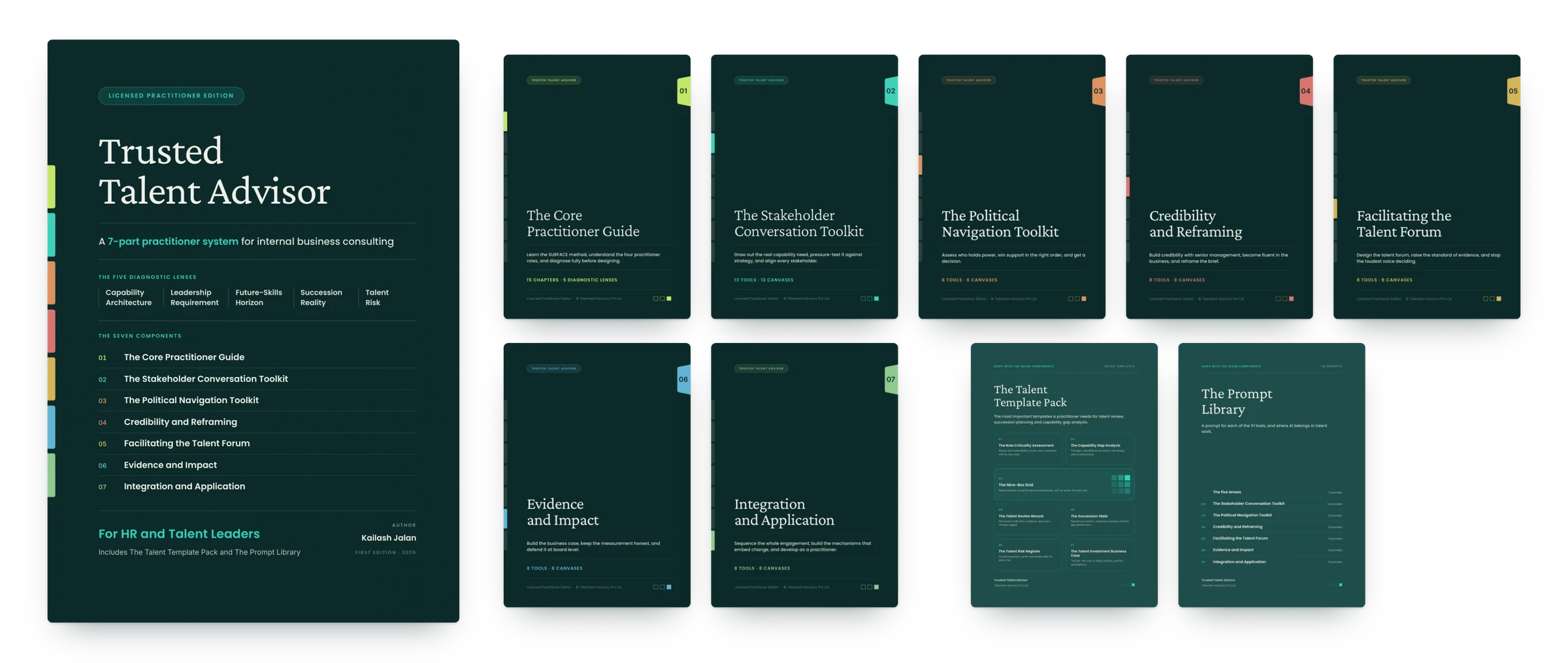
Trusted Talent Advisor
A seven-part practitioner system for HR and talent leaders: 51 tools, The Talent Template Pack and The Prompt Library, with a lifetime licence for USD 1,299.
See the system